
Is a Chinese Organic Certificate Accepted as EU Organic (EU) 2018/848 for Sea Buckthorn Seed Oil Imported into Germany?
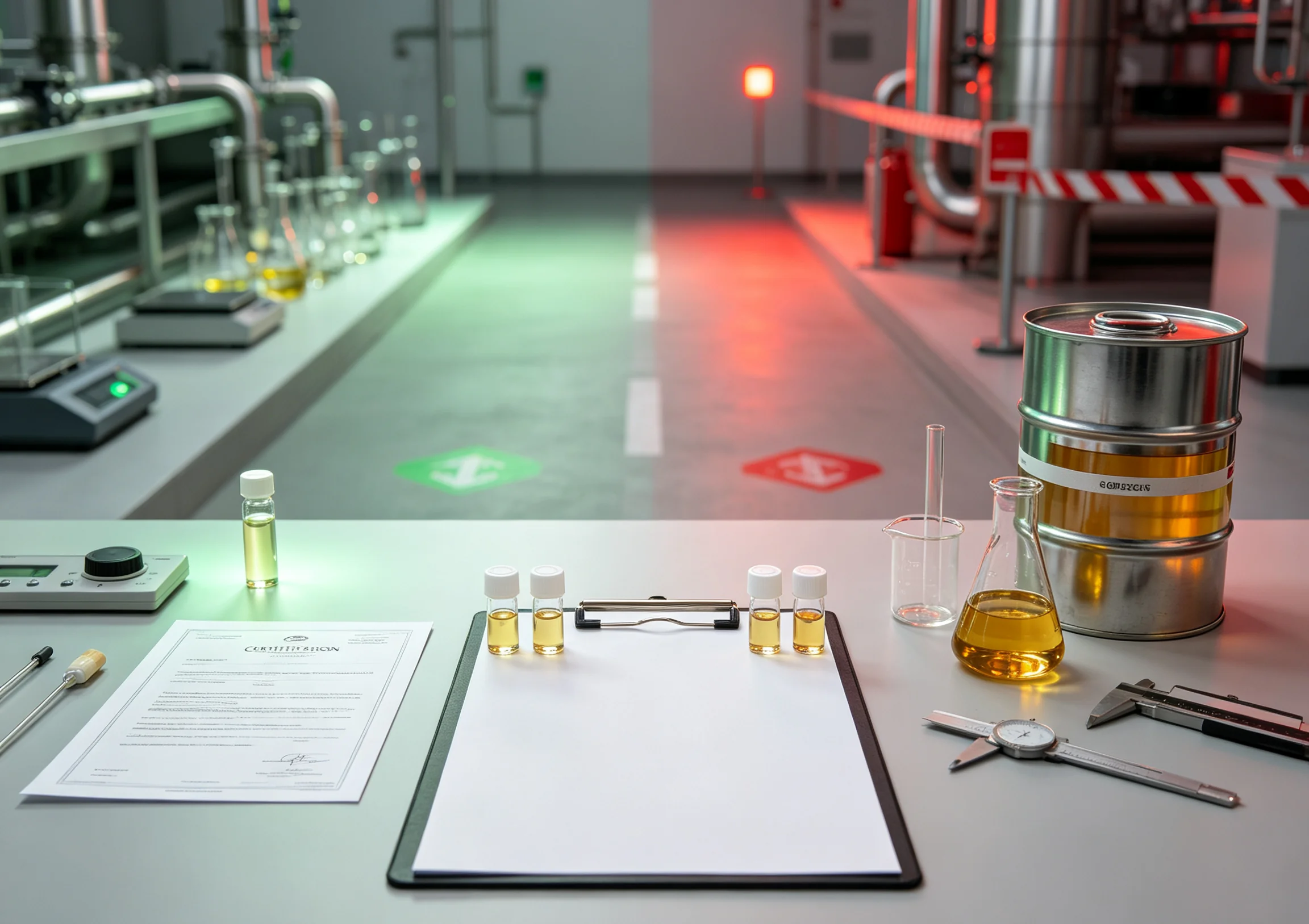
No. A Chinese organic certificate on its own is not automatically recognised as EU organic under Regulation (EU) 2018/848; to sell sea buckthorn seed oil as "Bio" in Germany, the chain of custody must be certified by an EU-recognised control body (for example Ecocert, BCS Öko-Garantie, CERES or Kiwa — always verify current recognition status), or the shipment must enter under an equivalence arrangement or an organic import authorisation, and each batch must be backed by a valid transaction certificate.
This guide is written for German contract manufacturers, soft capsule toll manufacturers and natural cosmetic OEM/ODM plants that buy sea buckthorn seed oil (Sanddorn-Samenöl) from China. It answers the question that quality and regulatory managers actually ask at goods-in: does this certificate allow us to put the EU organic leaf on the finished product, and if not, what do we do about it.
Why Is Organic Equivalence the First Gate for German Manufacturers?
Organic status is not a marketing detail in Germany — it is a market access condition.
German consumers treat the "Bio" label as a baseline expectation rather than a premium extra, and retail and brand customers (dm, organic retailers, pharmacy lines and private label programmes) build their specifications around it. For a contract manufacturer, the consequence is direct: if the incoming oil cannot be proven organic under EU rules, the entire Bio product line cannot be released, regardless of how good the oil is.
Three practical reasons make this the first gate rather than a late-stage check:
- The certificate determines whether the finished product may carry the EU organic logo and the control body code (for example a DE-ÖKO-xxx style code).
- It determines whether the batch can be traced through an unbroken organic chain from field to pressing to filling.
- It determines whether a customer or certification audit will pass — a failed organic evidence check is a major non-conformity, not a documentation remark.
From the buyer's side, the cost of getting this wrong is asymmetric. A rejected batch means rework, a downgrade to conventional status with the organic premium lost, and in the worst case a customer audit finding that puts the framework agreement at risk.
What Does Regulation (EU) 2018/848 Actually Require for Imported Organic Oils?
Regulation (EU) 2018/848 is the EU framework for organic production and labelling of organic products. It replaced the older Regulation (EC) 834/2007 and sets the rules for how organic status is established, controlled and documented.
For an imported vegetable oil such as sea buckthorn seed oil, the regulation requires, in substance:
- Certified organic production at origin: cultivation and harvesting according to organic rules (no synthetic pesticides or fertilisers within the conversion period, restricted inputs).
- Certified organic processing: pressing, extraction, refining, blending and packing operations must themselves be within the certified scope.
- Control by an EU-recognised control body: the operator must be inspected by a control body or authority recognised by the European Commission for the relevant product category and third country.
- Documented traceability: an unbroken chain from the plot through to the exported lot, with records available for inspection.
- Consignment-level documentation: each shipment moving within or into the EU organic chain must be accompanied by a transaction certificate (often referred to as a TC).
- Correct labelling: the EU organic logo, the control body code, and the indication of origin (EU / non-EU agriculture, or a specific country).
One of the most misunderstood points is the "certified processing" requirement. A certificate that covers only growing or only wild collection does not automatically permit the operator to press and export organic oil. The scope section of the certificate matters as much as the certificate itself.

How Does Chinese Organic Certification Differ from EU Organic?
China operates its own national organic standard (GB/T 19630) with its own certification scheme and its own list of approved certification bodies. It is a credible and widely used standard in the Chinese domestic market and in supply chains that accept it.
The critical point for a German buyer is that the two systems are separate:
- GB/T 19630 certification is issued under Chinese rules by Chinese-approved bodies.
- EU organic status under (EU) 2018/848 requires control by a body recognised for that purpose at EU level.
- The two are not automatically equivalent, and a Chinese organic logo cannot simply be relabelled as the EU organic leaf.
This does not mean Chinese-origin organic sea buckthorn oil is unavailable. In practice, compliant supply usually comes through one of the routes described below, rather than through a domestic Chinese certificate on its own.
Note on country-level equivalence: the EU may recognise certain third-country systems or control bodies for specific product categories. Whether any particular arrangement applies to sea buckthorn seed oil at any given time must be confirmed against the current European Commission list and the control body's scope. Treat this as a verification step, not an assumption.

Which Two Routes Can Make a Chinese-Sourced Oil Compliant in the EU?
In practice, a Chinese-origin organic oil reaches EU-compliant status through one of two routes.
| Route | How it works | What the buyer must see | Typical caution |
|---|---|---|---|
| Certification by an EU-recognised control body | The Chinese operator (farm, presser, exporter) is inspected and certified by a control body recognised at EU level for organic products | Certificate naming the EU-recognised body, scope covering oilseeds / vegetable oil pressing and export, plus a batch transaction certificate | Confirm the body's recognition covers organic products for the relevant third country — do not rely on the logo alone |
| Equivalence arrangement or organic import authorisation | The shipment enters under a recognised equivalence framework or with an organic import authorisation issued for the consignment | Import authorisation documentation, transaction certificate, and matching lot identity on all papers | Authorisations are consignment-specific and time-bound; they must match the actual shipment |
How Do You Verify an Organic Certificate in Five Checks?
Use this checklist at goods-in and at supplier approval. It is designed to be completed in minutes once the documents are in hand.
| Check | What to look for | Pass condition | If it fails |
|---|---|---|---|
| 1. Control body | Name, EU recognition status, accreditation/approval reference | Body is recognised for organic control; reference is verifiable | Treat as non-organic; request EU-recognised certification |
| 2. Scope of certification | Whether growing, wild collection, pressing, refining, packing and export are all listed | Pressing and export are explicitly in scope | Downgrade to conventional or reject for Bio lines |
| 3. Validity dates | Issue and expiry dates | Valid through the planned production and delivery window | Certificates expiring within roughly six months are a planning risk |
| 4. Chain of custody | Plot → presser → trader → exporter, each certified | Every link in the chain holds valid organic certification | Break in the chain invalidates organic status for that lot |
| 5. Transaction certificate | Batch TC matching lot number, quantity and dates | TC corresponds exactly to the delivered lot | Mismatched or missing TC: quarantine the lot |
Do Food and Cosmetic Uses Need the Same Organic Evidence?
No — and confusing the two is a common source of audit findings.
Sea buckthorn seed oil has a dual-use character: it can be an ingredient in food supplements (oral oils, soft capsules) or in cosmetics (facial oils, creams). The organic evidence follows the end use.
| Dimension | Food supplement route | Cosmetic route |
|---|---|---|
| Organic framework | (EU) 2018/848 organic production and labelling | Private standards, primarily COSMOS-standard (and legacy BDIH-style schemes) |
| Recognised evidence | EU-recognised control body certificate, import authorisation, TC | COSMOS-approved or compliant input; organic input if "organic" is claimed |
| Label driver | EU organic logo, control body code, origin statement | COSMOS NATURAL / COSMOS ORGANIC label, ingredient listing (INCI) |
| Typical error | Assuming a COSMOS input is automatically EU organic | Using a food organic certificate to justify a cosmetic "Bio" claim |
What Happens If Equivalence Cannot Be Proven?
When organic equivalence cannot be demonstrated, the material does not become unsafe — it becomes non-organic. The consequences are commercial and procedural rather than a food safety issue, but they are significant:
- The batch is downgraded to conventional status, and the organic price premium is lost.
- Finished goods already produced may need relabelling or may be unsaleable on the Bio line.
- A customer or certification audit may record a non-conformity, particularly if the finished product carried organic claims.
- Re-validation is required if you switch source, which can take weeks because a new supplier needs sampling, testing and documentation review.
There are three realistic recovery options:
- Switch to an already EU-recognised source of the same material, ideally one already qualified in your approved supplier list (this is why dual sourcing matters).
- Use EU-origin material (for example Polish or other EU-pressed oil) for the Bio line, keeping the Chinese source for conventional products.
- Re-position the product as conventional, recalculating cost and retail price, and removing organic claims from artwork and listings.
Whichever option you take, record the decision. Auditors will ask not only what went wrong, but what you did next and how you prevented recurrence.
What Should Manufacturers Lock into Contracts and Quality Agreements?
Organic equivalence is much easier to manage as a contractual term than as a goods-in surprise. Experienced German buyers build the following into purchasing contracts and quality agreements (QSV):
- Certificate obligation: supplier warrants that all organic claims are backed by an EU-recognised control body or a valid equivalence/import route, and supplies the certificate, scope page and TC.
- Early renewal notice: supplier must flag certificate expiry at least 60 days ahead, so renewal never interrupts supply.
- Change control: any change of origin, growing area, pressing site or process must be notified in advance (30 days minimum, 60 preferred) and may trigger re-approval.
- Right of re-testing: the buyer may send samples to an ISO/IEC 17025 laboratory; non-conforming results are at the supplier's cost.
- Downgrade and compensation: if organic status is not recognised, the supplier bears the price difference and any documented rework costs.
- Zero tolerance for falsification: mismatched lot numbers, reused TCs or altered certificates are termination events, not negotiation points.
Adding these clauses costs a few lines at contract stage and removes most of the ambiguity at goods-in.
Conclusion and Next Steps
The question "is a Chinese organic certificate accepted as EU organic?" has a clear operational answer: not by itself. EU organic status under (EU) 2018/848 depends on control by an EU-recognised body or a valid equivalence/import route, documented by a transaction certificate for each lot, with the certificate scope explicitly covering pressing and export.
For German manufacturers, the workable approach is:
- Ask the route question at enquiry stage — which EU-recognised body, or which equivalence arrangement, applies.
- Verify with the five checks — control body, scope, validity, chain of custody, transaction certificate.
- Separate food and cosmetic evidence files so that dual-use material is never released on the wrong basis.
- Write the obligations into the contract — renewal notice, change control, re-testing rights, downgrade compensation.
- Keep a second qualified source so that a certificate problem never becomes a line stoppage.
If you are qualifying a Chinese sea buckthorn seed oil supplier for a German Bio line, send the five-check list before you send the price enquiry. You will eliminate most non-qualified suppliers in one round of emails, and the ones that remain will be worth sampling.
FAQ
1. Can a Chinese organic certificate be used to label sea buckthorn seed oil as "Bio" in Germany? Not on its own. The oil must come through an EU-recognised control body or an equivalence/import route, with a valid transaction certificate for the lot. Verify the control body's current recognition and scope before relying on any certificate.
2. What is an organic import authorisation, and who arranges it? It is the consignment-level documentation that allows an organic import to enter the EU organic chain. It is typically arranged by the importer or exporter with the control body, and it must match the actual shipment. Confirm responsibilities contractually.
3. Are Ecocert, BCS Öko-Garantie and CERES certificates all recognised in the EU? These are widely used control bodies for organic certification, but recognition is granted for defined scopes, product categories and third countries. Always verify the body's current recognition and that the scope covers your product — the brand name alone is not sufficient.
4. Why must the certificate scope cover the pressing stage? Because organic status must be maintained through processing. A certificate that only covers cultivation or wild collection does not demonstrate that pressing, packing and export were controlled to organic rules.
5. Is a transaction certificate (TC) needed for every batch? Yes. The TC links the delivered lot to the certified chain. A certificate without a matching TC, or a TC with a mismatched lot number, is a red flag that should quarantine the lot.
6. Does a cosmetic product need (EU) 2018/848 organic certification? Not necessarily. Cosmetic organic claims usually follow private standards such as COSMOS-standard. However, if a cosmetic product claims organic content, the organic input still needs credible organic evidence under the applicable standard.
7. What should we do if we discover a mismatched certificate after production? Quarantine remaining stock, verify with the control body, assess finished goods for labelling exposure, and notify affected customers. Document the investigation and corrective action — auditors will review the response, not just the error.
8. How often should organic certificates be re-verified? At initial approval, at each batch through the transaction certificate, and at least annually during supplier review. Add a 60-day expiry reminder so renewals never become emergencies.
9. Can we keep one organic evidence file for both food and cosmetic use? It is safer to keep separate files. The standards differ, the label rules differ, and mixing them is a common audit finding.
10. Is the organic certificate enough to release a batch? No. Organic status is separate from product safety. Release still requires the per-batch COA and the third-party testing file covering pesticide residues, heavy metals, benzo[a]pyrene and solvent residues where applicable.
This article was published on 2026-09-09, and last updated on 2026-09-09. The article will be continuously updated.