
What Should Australian Manufacturers Do When Batch-to-Batch Omega-3 Drift Exceeds ±3% in Sea Buckthorn Seed Oil?
Quarantine first, retest second, claim third: when batch omega-3 drifts beyond ±3%, lock liability with three artefacts—your 24-month retain sample, a third-party retest report, and the batch traceability record—then file for replacement, credit or concession within the 5–10 working days your contract allows, and convert the incident into a tighter consistency clause.
A ±3% tolerance is not an academic figure. It is the line between a routine delivery and a reformulation that can cost between AUD 5,000 and AUD 20,000, on top of AUD 500–2,000 per day if the line stops while you work it out.
In our experience supplying Australian manufacturers, most failed claims are not lost because the supplier is unreasonable. They are lost because the buyer cannot produce the retain sample, the retest report and the batch linkage at the same time. This article covers the retain system, the contract clause, the claim path and the prevention loop.


What Does the ±3% Batch Omega-3 Tolerance Actually Protect You From?
Three layers of loss sit behind that number.
Direct loss. A formulation built around a specific omega-3 load has to be rebuilt when the incoming oil moves. That is the AUD 5,000–20,000 reformulation cost, plus the trial material and the laboratory time.
Operational loss. If the batch has already been issued, you are looking at line downtime, typically modelled at AUD 500–2,000 per day, plus the knock-on to your own delivery promises.
Commercial loss. Downstream audits, a higher raw-material-caused return rate against your ≤3% target, and the internal credibility cost of explaining a preventable variance.
The ±3% figure exists because it matches how buyers actually score consistency: batch-to-batch omega-3 within ±3% on 95% or more of deliveries. Set the tolerance to match your KPI, and enforcement becomes arithmetic rather than argument.
How Do You Detect Drift Before It Reaches the Filling Line?
Detection is a trend problem, not a pass/fail event.
Test every incoming lot for the parameters that matter—omega-3, omega-6, ratio, PV, AV, odour and colour—and record them as a series. A single lot inside tolerance tells you little; three lots walking in the same direction tells you that something upstream has changed.
| Trigger | What it looks like | Action |
|---|---|---|
| Single lot outside ±3% | One result beyond tolerance | Quarantine and retest |
| Two consecutive lots moving the same way | Still inside tolerance, clear direction | Ask the supplier what changed |
| Omega drift plus colour or odour shift | ΔE or odour moves with the fatty acid profile | Suspect blending or origin change |
| Ratio moves while omega-3 holds | Profile imbalance | Check for fruit oil addition |

What Does a Defensible Retain Sample System Look Like?
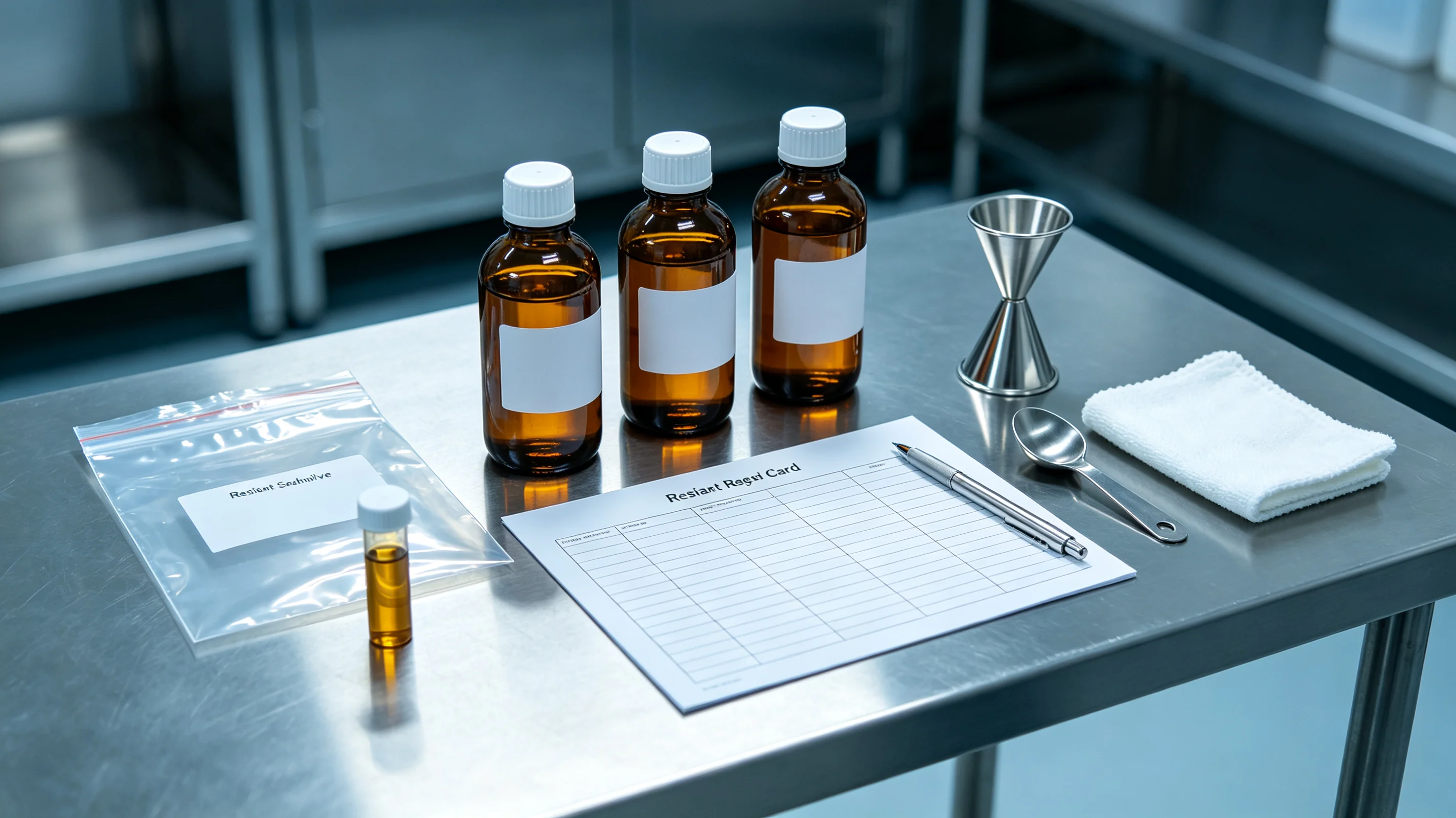
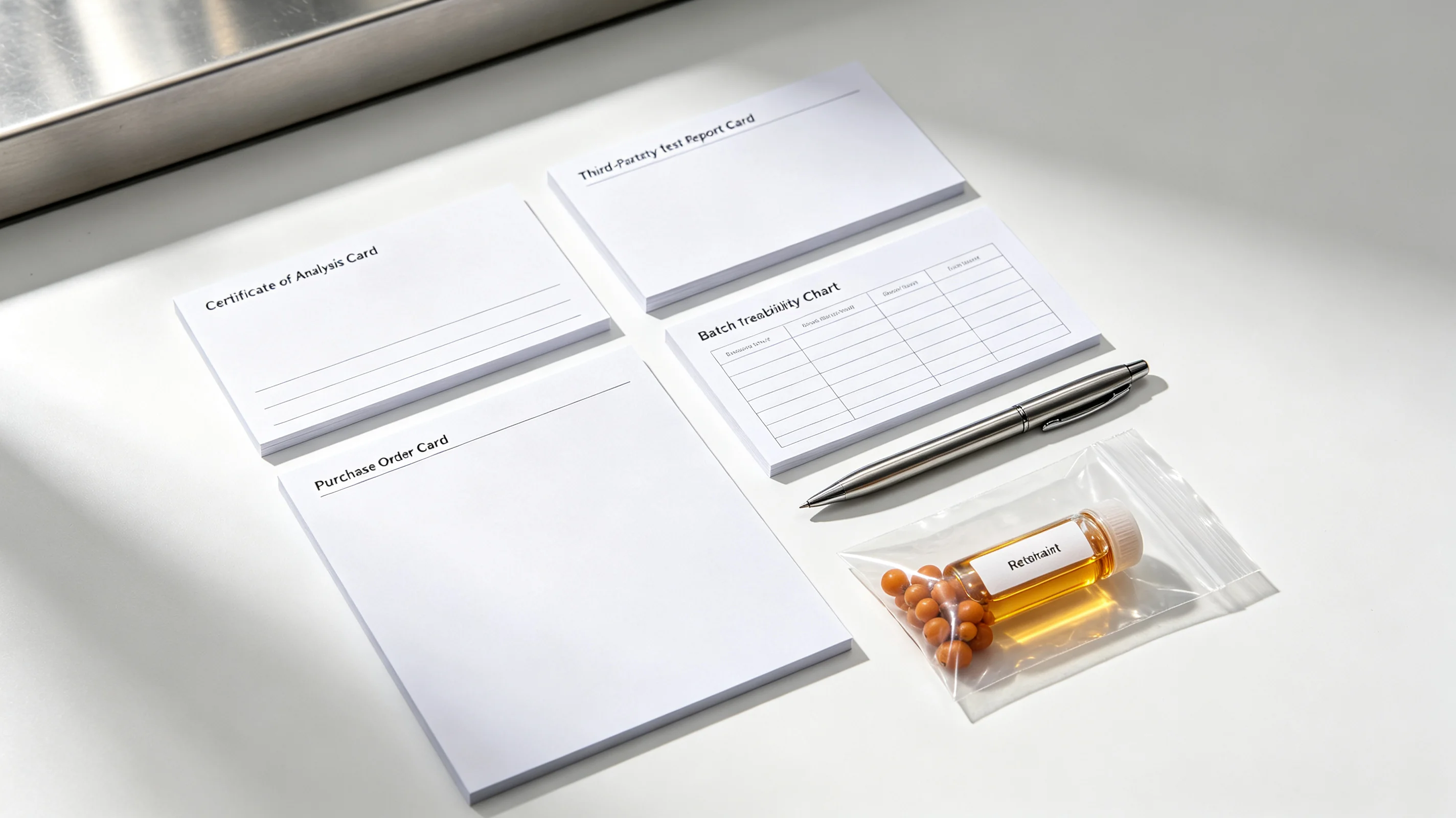
A retain sample is evidence only if it is identifiable, protected and linked to a batch.
| Field | Requirement | Common error |
|---|---|---|
| Volume | Enough for at least two full retests | A token vial that cannot be retested twice |
| Container | Sealed, light-protected, ideally nitrogen flushed | Open jar, headspace full of air |
| Storage | Cool, dark, stable temperature | Warehouse shelf exposed to heat |
| Labelling | Batch number + PO + date + supplier lot | Handwritten "sample 3" |
| Duration | 24 months minimum | Discarded after a few months |
| Log | Entry in a retain register linked to the QA file | No record at all |
The three mistakes that make retain samples worthless
No comparable reference. A retain from a different specification revision cannot prove drift. Keep at least one retain from the lot your formulation was validated on.
No controlled storage. Oil kept warm and exposed to light will degrade, and the degraded result will be read as the supplier's fault—or worse, as yours.
No linkage. A retain that cannot be tied to a batch number, a purchase order and a COA has no evidential value, no matter how carefully it was stored.
How Do You Write the Consistency Clause Into the Contract?
Consistency is enforceable only when it is written down. Start from this clause list.
| Clause item | Suggested wording intent | Why it matters |
|---|---|---|
| Batch variance | Omega-3 batch-to-batch variance ≤ ±3% | Converts "consistent" into a number |
| Reference basis | Measured value per lot; typical values excluded | Blocks typical-value defence |
| Retain obligation | Supplier retains 24 months; buyer retains 24 months | Both sides can retest |
| Retest laboratory | Named third party, or mutually agreed | Removes "your lab, your result" |
| Retest cost | Borne by the party found at fault | Creates incentive to be right |
| Judgement rule | Accept / concession with sign-off / reject | Removes case-by-case negotiation |
| Claim window | 5–10 working days from quarantine | Sets a clock both sides accept |
| Concession authority | Named role required to sign | Prevents informal acceptance |
What Is the Claim Path From Quarantine to Credit?
Speed matters less than sequence. Follow the order.
| Stage | Action | Timeframe | Evidence created |
|---|---|---|---|
| 1 | Quarantine the lot; do not issue to production | Immediate | Quarantine note with batch number |
| 2 | Assemble the evidence pack | Same day | COA, PO, clause reference, photos |
| 3 | Notify the supplier in writing | Same day | Written notification |
| 4 | Third-party retest, with the retain opened under record | Within days | Retest report |
| 5 | Joint liability determination | 5–10 working days | Agreed finding |
| 6 | Remedy: replacement, credit or signed concession | 5–10 working days | Credit note or replacement PO |
| 7 | Log into supplier scorecard | Quarterly | Scorecard entry |
What Evidence Package Do You Need to Win a Claim?
Assemble this pack on day one, before anyone argues about interpretation.
| Artefact | What it proves | If missing |
|---|---|---|
| Supplier COA (batch-specific) | What was promised | Supplier can claim a different spec |
| Your third-party retest report | What arrived | No independent measurement |
| Retain sample + opening record | Chain of custody | Sample integrity disputed |
| Batch-to-origin traceability record | Which lot, which origin | Cannot link result to shipment |
| PO and contract clause | What was agreed on remedies | No basis for remedy |
| Arrival photos and seal condition | Transport not at fault | Carrier blame shifts to you |
| Production usage record | Scope of impact | Cannot quantify loss |
How Do You Prevent Recurrence With Supplier Scoring and Dual Sourcing?
Every claim should end with a structural change, not just a credit note.
Score quarterly, act annually. Keep a scorecard—specification compliance, documentation completeness, responsiveness, remediation quality—with a target of 85 or better, and be willing to de-list at least one supplier a year. Scoring without consequences is administration, not control.
Keep the concentration low. Qualify three to five suppliers and hold your largest source at 50% or less of volume. When a drift problem repeats, you need an alternative that is already approved, not one you have to start qualifying.
Cover the switch window. Changing supplier typically leaves a two-to-four week gap. Cover it with safety stock of 20–30 days and a six-to-eight week ordering lead time, so a quality decision never becomes a stockout decision.
Close the loop. After every incident, revise the contract: a tighter tolerance, an added document requirement, or a new retest trigger. Suppliers honour what is written and measured.
FAQ
How much retain volume do I need per batch? Enough for at least two complete retests of the parameters you care about, plus a sealed reference portion. For most buyers working in 100–1,000 kg batches, that is a small volume relative to the lot but a decisive one in a dispute.
Who should hold the retain, buyer or supplier? Both. The supplier's retain protects against a sampling dispute; yours protects against a chain-of-custody dispute. Require a 24-month obligation on both sides in the contract.
What if the supplier rejects my third-party retest? Name the laboratory in the contract, or agree a mutual laboratory procedure, before the first shipment. If the laboratory is agreed in advance, a later rejection has no standing.
How long do I have to file a claim? Set it in the contract—5–10 working days from quarantine is a workable window. Without a contractual clock, delay becomes the supplier's best defence.
Can I still claim if I accepted the lot under concession and used it? Usually yes, if the concession was signed with a documented reservation of rights and the loss is traceable to the batch. Verbal or unconditional concessions make recovery very difficult.
What happens to retains after 24 months? Replace them. Retains exist to cover the commercial life of the batch plus a dispute window; beyond 24 months the sample itself may no longer represent what was delivered.
How do I cover the 2–4 week gap when switching suppliers? Hold safety stock of 20–30 days, order six to eight weeks ahead, and qualify the alternative before you need it. Treat qualification as routine work, not emergency work.
The variance is inside ±3% but my formulation is still unstable. Whose problem is it? Then the tolerance may be wrong for your process, or another parameter—PV, colour, odour—is the real driver. Review the whole specification with your formulator rather than tightening omega-3 alone.
Conclusion and Next Steps
Batch consistency is not something a supplier grants you. It is the product of a retain system that produces evidence, a contract that converts expectations into numbers, and a claim process that is followed in sequence. Get those three right and ±3% stops being a hope and becomes a managed control.
Four steps to put it in place:
- Stand up a retain register with 24-month retention, labelled by batch number, PO and date.
- Add the consistency clause: ±3% variance, 24-month mutual retain, named retest laboratory, 5–10 working day claim window.
- Pre-build your evidence pack template so it can be completed on the day of the incident.
- Run a quarterly scorecard against a target of 85, keep three to five qualified suppliers, and hold your top source at 50% or less.
Send us your batch size, annual volume and current consistency clause, and we will return a retain-and-claim clause set, a batch traceability template and a specification block you can hand straight to your QA and legal reviewers.
This article was published on 2026-09-08, and last updated on 2026-09-09. The article will be continuously updated.