
What Does the TGA AUST L Listing Process and Timeline Look Like for an Australian Sea Buckthorn Oil Finished Product?
An AUST L entry lists a finished product, not a raw material: it must be submitted to the ARTG by an Australian sponsor, and you should plan three to six months end to end—most of it spent on document preparation (formulation and claim evidence, specification and COA, stability data, GMP evidence or a manufacturer's statement, and the label draft), not on the assessment queue. Narrowing your claims to what the evidence supports is the single most effective way to shorten the timeline.
For QA and regulatory managers, the usual failure is not ignorance of the rules. It is underestimating the preparation phase: sponsor scheduling, incomplete stability data, and claims that come back because they reach past the evidence.
For a manufacturer, AUST L is the first gate a soft capsule has to pass before it can sit in the supplement channel. A topical oil is a different route entirely—industrial chemical introduction with an MSDS, not an AUST L listing. This article covers the three-party split, the document pack, the timeline, the claim boundaries and post-approval maintenance.

What Does AUST L Listing Actually Cover, and What Does It Not?
An AUST L number marks a listed medicine: a lower-risk category with a defined, permitted range of general claims. Three boundaries matter in practice.
It covers the finished product. The listing attaches to the formulation you sell, with its ingredients, dosage, label and claims. Your oil does not get its own listing; it contributes evidence.
It does not certify your raw material. Your supplier's role is to supply a defensible specification, batch COAs, stability support, GMP evidence or a manufacturer's statement, and traceability. Those documents carry weight because they substantiate the finished product, not because they are registered.
It is not the topical route. A sea buckthorn oil sold as a cosmetic or topical product follows industrial chemical introduction requirements with an MSDS, rather than the listed medicine pathway. Deciding which route applies is the first decision, because it determines the whole document set.
Who Has to Do What: Sponsor, Brand and Raw Material Supplier?
Three parties, three distinct deliverables.
| Party | Owns | Deliverables | Where it stalls |
|---|---|---|---|
| Australian sponsor | Submission and regulatory communication | ARTG submission, record maintenance, regulator responses | Scheduling and response queues |
| Brand / manufacturer | Formulation, label, claim evidence | Formula and ingredient list, label draft, claim rationale, batch and expiry rules | Claims written before evidence exists |
| Raw material supplier | Substantiation of the oil | Specification and COA, fatty acid profile, stability data, GMP evidence or manufacturer's statement, MSDS, origin traceability | Outdated or version-mismatched documents |
The handover points where submissions stall
Specification version mismatch. The sponsor holds version 2 of the spec while the supplier quotes version 1. Reconcile versions before submission, not after a request for information.
Stability data without batch linkage. Stability support for a 24–36 month shelf life needs to be tied to specific batches and packaging, or it will not answer the question.
Expired GMP evidence. Certificates lapse. Build a renewal calendar so the document is valid on the day it is reviewed, not just on the day it was issued.

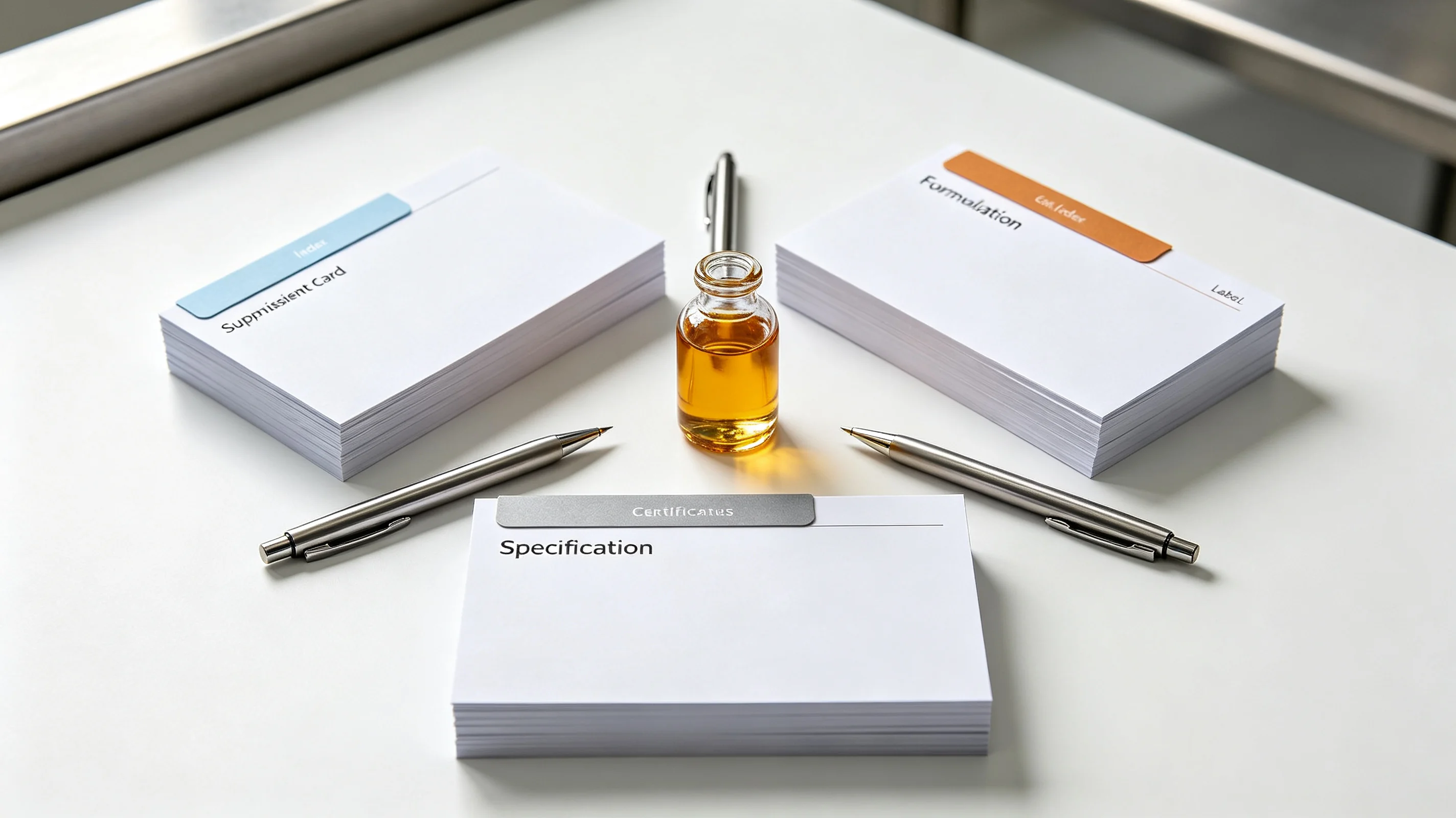
What Documents Does the Submission Need?
Assemble the pack once, then reuse it per SKU.
| Document | What "good" looks like | Common defect |
|---|---|---|
| Formula and ingredient list | Complete, with grades and quantities | Unspecified excipients |
| Raw material specification | Agreed block, version controlled | Verbal or email-only spec |
| Batch COA | Batch-specific, method stated, full panel | Typical values presented as batch results |
| Fatty acid profile | Omega-3, omega-6, ratio, components listed | Summary line only |
| Stability data | Supports 24–36 months, batch and pack linked | No packaging linkage |
| GMP evidence | Certificate or manufacturer's statement, valid | Expired or unverifiable |
| MSDS | Current, English, classification stated | Old revision |
| Heavy metals and microbiology | Pb, As, Hg each < 0.1 mg/kg; microbial limits | Screen missing or partial |
| Origin traceability | Batch to growing base | No batch linkage |
| Label draft | English, all required elements | Missing warning statements |
| Claim rationale | Each claim tied to evidence | Claims without substantiation |

How Long Does It Really Take, and What Slows It Down?
The three-to-six month figure is mostly preparation.
| Stage | Typical duration | Output | What slows it |
|---|---|---|---|
| Document pack assembly | 4–8 weeks | Complete submission file | Waiting on supplier documents |
| Sponsor review and submission | 1–3 weeks | ARTG submission | Sponsor scheduling |
| Assessment and any requests | 4–10 weeks | Requests answered | Claims needing rework |
| Listing takes effect | — | AUST L number | Outstanding documents |
The practical implication for planning: book your sponsor early, and do not commit a launch date until the document pack is complete. The pack is the schedule.
Which Claims Can You List, and Which Ones Trigger Rework?
Claims are where timelines are lost, so decide them against evidence rather than against ambition.
| Direction | Generally workable | Likely to trigger rework |
|---|---|---|
| Composition | Omega-3 content, omega-6 content, ratio, extraction method | Converting ALA into an EPA/DHA equivalent |
| Suitability | Vegan and vegetarian, where the capsule and inputs qualify | Suitability claims without input verification |
| General support | General health maintenance and nutritional support wording | Therapeutic or treatment language |
| Origin and process | Country of origin, supercritical CO₂ extraction | Implying a therapeutic benefit from the process |
| Comparisons | Factual composition comparisons | Comparative efficacy claims |
What Must the Label Carry to Pass ACCC and TGA Checks?
Labels are a checklist, not a design exercise.
| Element | Requirement | Typical rework cause |
|---|---|---|
| Ingredients | Complete, English, consistent with the formula | Excipient omitted |
| Dosage | Serving size and directions | Directions ambiguous |
| Warning statements | Required statements present and correctly worded | Statement missing or paraphrased |
| Country of origin | Clearly stated | Absent or vague |
| Batch number | Matches the traceability record | Numbering convention differs from the COA |
| Expiry date | Supported by stability data | Date exceeds supported shelf life |
How Do You Keep the Listing Valid After Approval?
Approval is the start of maintenance, not the end of the project.
| Maintenance item | Cadence | Owner |
|---|---|---|
| Change control on inputs | Per change | Brand + supplier notification |
| Certificate and document renewal | Annual or per expiry | Supplier, tracked by brand |
| Retain samples | 24 months, batch linked | Both sides |
| Batch testing | Per batch, budget AUD 300–800 | QA or third-party lab |
| Complaint response | Within 24 hours | QA |
| Traceability completeness | Target 99% or better | QA + supplier |
| Stability follow-up | Ongoing | Brand + supplier |
FAQ
Can the raw material supplier submit the AUST L application for the brand? No. Submission to the ARTG is made by an Australian sponsor. The supplier's role is to provide the substantiation pack that makes the submission possible.
What if we do not have an Australian sponsor? You need one. Engage a sponsor early, because their scheduling is part of your timeline, and brief them on intended claims before artwork is commissioned.
When does the 3–6 month clock start? Practically, when the document pack is complete and the sponsor submits. Most of the elapsed time before that is preparation, which is why planning from the decision date rather than the submission date gives more realistic launch dates.
Do we need to re-list if we change raw material supplier? Not automatically, but the change must go through change control, and any resulting change to specification, stability or labelling needs assessment. Silent supplier changes are a common audit finding.
Is organic certification required for the listing? Not as a listing requirement. It matters commercially and for certain retail channels, and if you claim organic you must hold a current, verifiable certificate such as ACO or NASAA.
Does a topical oil skip AUST L? A cosmetic or topical product follows a different pathway, centred on industrial chemical introduction and an MSDS, rather than the listed medicine route. Confirm the intended use before choosing the pathway, because it determines the whole document set.
Can we run trial batches while the listing is pending? Trial and stability batches are normal during development. Commercial supply with therapeutic-style presentation before the listing is in place is not—keep the distinction explicit in your project plan.
What is the most common reason a submission is knocked back? Claims that exceed the evidence. In plant omega-3 projects specifically, it is usually an implied EPA/DHA equivalence or therapeutic wording that entered the copy during marketing review.
Conclusion and Next Steps
AUST L timelines are document timelines. The assessment queue matters far less than whether your formulation, specification, stability file, GMP evidence and claims line up before submission. Sponsors can only submit what you give them.
Four steps to keep the file moving:
- Engage the sponsor early and agree the list of claims you can actually support.
- Request the full substantiation pack from your oil supplier in one go—specification, COA, fatty acid profile, stability, GMP evidence or manufacturer's statement, MSDS, traceability.
- Draft the English label against the element checklist and pre-review it before artwork.
- Set up post-approval maintenance: change control, 24-month retains, per-batch testing budget, and complaint response within 24 hours.
Send us your intended claims, dosage form and target channel, and we will return a substantiation pack, a batch COA example and a stability summary your sponsor can put straight into the submission file.
This article was published on 2026-09-08, and last updated on 2026-09-09. The article will be continuously updated.